Natalia Goncharova, Espagnole, 1916, which sold for a record $10.2 million at Christie’s in 2010. Genuine high-quality works like these are few.
COURTESY CHRISTIE’S
Scandals have never been in short supply in the world of Russian avant-garde art, but the last few years have seen a bumper crop, with the controversial arrest of a respected Russian curator on fraud charges and, more recently, the attempt by the Russian Ministry of Culture to ban a book full of reproductions of allegedly fake paintings by Russia’s most famous woman artist, Natalia Goncharova.
These were noteworthy events even in this sometimes murky world. Specialists know that most of the Russian avant-garde works available on the market are fakes—ten times as many fakes as genuine works, said James Butterwick, who has been dealing in Russian avant-garde art in London for 20 years, and others in the field backed him up.
These days the major auction houses are extremely cautious and reject any work whose incomplete provenance arouses doubts, but dubious works continue to proliferate in minor auction houses and art galleries all over Europe. Russian and Western experts who certify artworks regularly accuse one another of corruption or negligence.
Now a new organization, the London-based Russian Avant-Garde Research Project (RARP), is entering the field with an ambitious goal. “We want to introduce new standards of scholarship that will help solve the main problems in the field of Russian art history,” said Konstantin Akinsha, one of RARP’s founders and a member of its board.
RARP will not authenticate artworks or issue certificates. It will have two main directions, Akinsha said. “One is the research of provenance ‘fairy tales’ circulating in the art market,” largely through the study of museum archives, including those of defunct museums.
The first research project, to be undertaken in cooperation with the Tretyakov Gallery in Moscow, will be the complete digitization of the Goncharova archive, which is housed in the museum: a trove of more than 2,000 documents, including diaries, notebooks, and letters. RARP will supply the equipment for the materials to be put online and annotated by curator Evgeniya Illukhina. “Publication of this material will help clear up many Goncharova provenances,” Akinsha said.
RARP will also support research projects focused on such crucial sources of information as the inventories of the museums of avant-garde art that flourished in the Soviet Union during the 1920s. The Museum of Painterly Culture was established in Moscow in 1922 (seven years before the founding of the Museum of Modern Art), while a network of 30 provincial museums disseminated visual culture to the masses. Having precise inventories for these institutions, and for exhibitions that were sent to the West, would unmask many fanciful provenances.
“Provenance, history is all-important in this field,” Butterwick emphasized. “I have seen fake certificates that said the pictures came from the Museum of Painterly Culture. Having an inventory could put a stop to that.”
RARP is supported by donors from Russia and the West, of whom the best known is the Russian banker Petr Aven, a well-known collector of Russian modernism and a longtime scourge of abuses in the field. Members of its governing board are the American Kandinsky scholar Vivian Endicott Barnett, Natalia Murray of the Courtauld Institute, Mark Pollard, Edward Hall Professor of Archaeological Science at Oxford University, and Akinsha, an independent art historian and curator who has been largely responsible for publicizing the problem of Russian avant-garde fakes in articles for ARTnews over the last 30 years.
RARP’s second major direction, Akinsha said, will be to study the materials and techniques of Russian avant-garde artists in depth and detail, taking advantage of all the newest methods and technologies. “To date, this study has been largely piecemeal and often focused on authenticity questions rather than on establishing a baseline of original practice,” Akinsha said. RARP plans to undertake a survey of Russian avant-garde paintings in major museum collections in order to generate a database of reliable information from which larger technical and art-historical issues can be explored. “And creating a bank of samples and studying the materials and techniques of the major artists will help us to achieve a new level of technical analysis of Russian art,” Akinsha explained.
Aside from the Tretyakov, RARP is negotiating with three other major museums to examine the works in their collections. Akinsha said that a major stimulus to the formation of RARP was the Goncharova scandal of 2011: the publication in the West of two fat volumes filled with reproductions of allegedly fake works by the artist.
Alexandra Exter, A costume design for Romeo and Juliet: Juliet, 1920–21.
COURTESY CHRISTIE’S
Goncharova (1881–1962) is one of the world’s most expensive women artists; her 1916 painting Espagnolesold for a record $10.2 million at Christie’s London in 2010. Prices have risen steeply, but genuine high-quality works like this one are few, which has led to the proliferation of forgeries. Goncharova and another Russian woman, Alexandra Exter, are among the world’s most frequently forged women artists.
The two books—Anthony Parton’s The Art and Design of Natalia Goncharova, and Denise Bazetoux’s Natalia Gontcharova: son oeuvre entre tradition et modernité—were blasted by the Tretyakov curators, who appeared at a press conference in Moscow hosted by RIA Novosti, the government news agency, to give their views maximum exposure. In Parton’s book, the curators said, at least 150 of the 600 works illustrated were fakes. The Bazetoux volume was even worse. Of the approximately 1,500 works illustrated, the curators said, about 60 to 70 percent were fake.
In a letter to the Ministry of Culture, the curators charged that a “grand scale operation…criminal in its essence” and with “openly commercial aims” was destroying “efforts to popularize Russian art in the West and the rapprochement of our cultures.” They asserted their “moral right” to ask the ministry to deal with the problem “on a state level.”
The ministry obliged and filed a claim in the Arbitration Court, the country’s supreme commercial tribunal, asking that the sale of Parton’s book be prohibited in Russia. Parton did not respond to a request for comment.
The court also demanded that the publisher stop printing the book and recall all existing copies. Fifty years after her death, it seems, Goncharova can still provoke as much outrage as she did in 1910, when she painted her face and paraded topless through the streets of Moscow.
It is noteworthy that, for once, the move had nothing to do with politics or religion or even sex. The book’s distribution, the ministry claimed, would damage the cultural heritage of Russia, and the basis for the claim was those many illustrations of allegedly fake paintings. The Arbitration Court’s decision is expected in May, but some Russian book distributors have already reached a settlement with the ministry. In any case, it is unlikely that the Russian tribunal’s ruling will have more than moral force in the West.
“Despite all the scandals rocking the market,” Akinsha said, “highly questionable works by Malevich, El Lissitzky, and other artists of the Russian avant-garde are appearing on museum walls with disturbing frequency and are reproduced in museum catalogues and art books. They pollute the history of Russian art, and they are toxic not only for the art trade, but also for future scholarship.”
Is it possible to clean the Augean stables of the Russian avant-garde? “It will be very difficult,” Akinsha said, “but it’s possible. I hope RARP will be the first step.”
Sylvia Hochfield is a contributing editor at ARTnews.
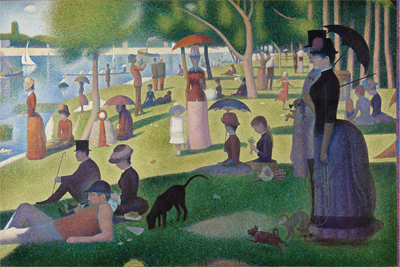
The painting was George Seurat’s Neo-impressionist work A Sunday Afternoon on the Island of La Grande Jatte, his famous scene of Parisians in a waterside park. As my eye scanned the canvas, jumping from boats to people to clouds, it caught on a tree.
Here were no seamless bands of color, no blended patches of tint as in so many other paintings. The tree was made up of countless specks—a smattering of separate orange, yellow, and blue dots. The boats on the water, the people on the lawn, their faces and clothes—all were a sprinkling of motes, as if the canvas had been caught out in a rain of paint.
Out of the blue, I remembered the ascetic Bahiya, who asked the Buddha to teach him the path leading to happiness. “When seeing,” the Buddha said, “just see; when hearing, just hear; when knowing, just know; and when thinking, just think.” (Udana 1.10) It was all in how you looked at it. The Bahiya text is deceptively simple. In one sense, it means: Don’t daydream. Pay full attention to what you’re seeing. But there’s more to these words than you might think. Or maybe less.
I did a double take when my meditation teacher, Achan Sobin Namto, explained the deeper meaning of this attention practice. “If we could focus precisely on the present moment…,” he once wrote, “the eye would not be able to identify objects coming into the area of perception.” Ultimately, he said, following the Bahiya formula meant to see mere color instead of recognizing what you were looking at. It was possible to do this because there was a split-second time lag between (1) sensing the bare image and (2) recognition. (The same applies to perceiving sound, smell, taste, touch, and mental phenomena such as feeling.) If mindfulness were quick enough, you could catch the moment of bare seeing.
Wait a minute—had I heard right? “So if I really stay in the present moment,” I asked, “I’ll see a cup in front of me and not recognize it?”
“Absolutely,” Achan said.
“When pigs fly,” you might be thinking. Achan Sobin was once skeptical, too. “Impossible!” he’d said when his own instructor explained the idea. Later he spent decades teaching it to others.
To understand the teaching Bahiya received, it helps to remember the Buddhist distinction between ultimate and conventional truth. Consider the painting again: close-up, you see meaningless flecks of tint that don’t represent anything. Beings and objects, time and place, have vanished. The Seine, the trees, the woman’s face—all have exploded into particles, scattered across space. But when you step back from the picture, recognizable shapes leap into view as the eye “pulls” the specks together.
The individual points of color, and the identities that coalesce when the eye connects them, occupy the same space. From one vantage point there is a vista of permanent beings and things. From another, there’s no solid ground—only empty sensation that you can’t name. The painting presents a visual metaphor for conventional truth versus ultimate reality; self versus nonself.
The Bahiya teaching tells us to break our habit of looking at experience in terms of labels or concepts and instead observe ultimate reality directly. This is done by paying attention to bare seeing, hearing, smelling, touching, tasting, and feeling in their most primitive state, before your inner narrator names them. By repeatedly watching these events you’ll discover there is nothing personal about the act of perception.
Normally you think, “I am seeing.” Yet in the ultimate sense, the seeing that happens isn’t anyone’s. Although hearing occurs, there’s no self who hears. Rather than a homogeneous entity, we find a collection of parts. Unless observed closely, what we regard as the self appears to be a solid, personal identity that perceives things. But in truth there is no metabeing who unifies the parts. All our actions happen without an agent, or self, performing them. There is no seer, just the seeing; no hearer, just the hearing.
A Sunday on La Grande Jatte, Georges Seurat, 1884-86, oil on canvas, 81 ¾ x 121 ¼ inches
Distinguishing the tree in the painting from the specks it consists of may be a walk in the park. But it’s much more challenging to learn to separate the named things we’re familiar with from the bare seeing, hearing, and touching of actual experience. To master this skill, we must turn our attention again and again to direct experience until our mindfulness is fast enough to notice bare sights, sounds, touches and so on before recognition takes place. Even when practicing very diligently, the remarkable experience of observing bare sense-perception usually only happens when we’re least expecting it.
One morning, during a meditation retreat, I heard the sound of a bird. A mundane event, right? Except the sound was a quick whiplash of sensation that wasn’t connected to any named thing—least of all a creature called “blackcapped chickadee.”
At first I didn’t even recognize the sensation as an auditory form as opposed to a sight or smell. The next moment, the mental dots connected and the word “bird” slid into the mind. But the label didn’t erase the experience. Some veil had slipped, if just for a second.
When Achan Sobin walked in, I could hardly wait to blurt out: “It’s just a sound! It has nothing to do with the bird.” The event had somehow shaken my world.
“Nothing to do with the bird?” he asked.
Bingo.
He laughed and nodded. “Very good!”
“But it’s not even a sound.”
“No,” he confirmed, “by the truth, not even a sound.”
Stories of meditators experiencing bare awareness are common in the Buddhist world. The English monk Kapilavaddho Bhikkhu describes casually looking at his left hand, when “suddenly… the hand had lost all sense of solidity… Here, all that was presented to the eye was color.” In her memoir Hidden Spring: A Buddhist Woman Confronts Cancer, Sandy Boucher reports that when she first tried to mindfully observe pain, the feeling seemed very solid and she wanted to scream. But when she stopped labeling the pain as anything and ceased defining it as part of her self, a shift happened: “Finally there were only the sensations—without a name or a definition or association—only an elemental vibration of phenomena expressing life. For a few moments I was able to stay with this… separate from my identifications and desires. Then I fell back into my ‘I’ and experienced the sensations as if they were attached to ‘me,’ and they became pain again.”
The clincher for me came when my Christian mother attended a meditation retreat, expecting nothing but sore knees. “For the first time,” she said afterward, “I’d seen color only, without any label attached, and only a moment later did I realize I’d been looking at the familiar orange drapes.” But is it possible to function in ordinary life when seeing only color patches? No, you have to recognize sights and other sense-impressions when writing, cooking, and even teaching the dharma. To follow the Bahiya teaching doesn’t mean giving up the concepts of conventional reality altogether. The point is to devote some time every day to formal insight meditation during which you focus on bare sense-perception, until that practice gives rise to clear and direct insight into nonself (during daily actvities you can use broader attention). By paying attention to sensory experience as it is happening—and not getting caught up in the labels, preferences, thoughts, and emotions that happen in the split seconds after bare sense-data impinge on our awareness—we learn to see the suffering involved in getting caught up. And by seeing that suffering, we learn to free ourselves from it.
We learn this because when we can separate bare perception from conventional meanings, the feeling that an experience is happening to “me” begins to drop away. We discover that instead of being inherent in perception, the notion of a self is a deep-seated belief unconsciously added to it. If we focus on stopping short at bare perception before any concepts arise to complicate it, nonself will get clearer and clearer, since it’s the natural state of things, always there to be seen. And the clearer our understanding of nonself, the less we’ll suffer. Although initially the clinging to self disappears only when we’re very mindful, those moments free of delusion give deeper insight a chance to arise, and eventually wisdom becomes strong enough to trigger a permanent change of outlook. But even before that permanent change, the memory of having seen nonself directly—even for one moment—stays with us, and most of the time we feel much lighter than we used to.
For most of us, however, the permanent change of outlook is a long way down the path. Even observing bare sense-data for a few moments, if we truly do it, is nothing to sneeze at. The Burmese meditation master Mahasi Sayadaw wrote, “It is no easy matter to stop short at just seeing.” Although the aim from day one in insight meditation practice is to observe bare perception, it won’t actually happen, he says, until mindfulness and other factors reach an intermediate level.
In the early stages of meditation, you’ll still perceive only named, conventional objects, which are concepts. That’s fine. But it will help to focus on the knowing itself––that is, on the act of hearing, touching, seeing, and so on––rather than on the sense-impression per se. Further, right understanding will guide your effort toward the target. If you realize the aim is to know bare perception before the mind names or describes the experience, you’ll eventually be able to do it—paradoxically, though, only when you aren’t consciously trying to. (And by the way, although I’ve been emphasizing color and sound, in practice you’ll observe tactile sensations more often than any others.)
As we reach the intermediate stages of insight meditation, we begin to see that our experience isn’t an unbroken flow but rather a series of separate moments of consciousness that arise and die out, one at a time, with incredible speed. The mind that sees something quickly dies, and a different consciousness hears a sound. No self or soul carries over from one perceptual act to the next. In truth, your life-span is only one moment long. Buddhaghosa, the fifth-century Indian Buddhist scholar, wrote: “The being of the present moment has not lived, it does live just now, but it will not live in the future.” While you’ve been reading this article, thousands of different “beings” have arisen and died in the very chair you’re sitting in. No wonder the Buddha called consciousness a “conjuring trick”! (Samyutta Nikaya 22.95)
In daily life the separate moments seem to blur together, concealing the truth that birth and death are always occurring. This is part of the reason we buy into the conventional picture of a lasting self. Nonself only begins to be clear when the illusion of seamlessness disappears and we experience the gaps in the continuity, when we actually see the mind and its object arising and dying together from instant to instant. Then we may discover, as Mahasi Sayadaw wrote, that “the concept of a human form with its head, hands, and other parts is nowhere to be found.”
We’re not going to live in a world of nameless sensation forever. But glimpsing nonself clearly, even for one moment, puts ordinary truth in perspective. When the conventional picture returns, we regard it differently. What a relief when we no longer have to take our “selves” so seriously! We can still be responsible family members and effective employees; but we won’t suffer as much when problems arise. The anger, hurt, or fear that usually comes up when the boss berates us—or a loved one betrays us or the body gets sick—will be much weaker and shorter-lived. And when it’s absolutely clear that no phenomenon, including consciousness, truly belongs to us, we can realize the happiness of nibbana as Bahiya did.
- See more at: http://tricycle.org/magazine/disconnect-dots/?utm_source=Tricycle&utm_campaign=206583dceb-Daily_Dharma_May_23_201605_23_2016&utm_medium=email&utm_term=0_1641abe55e-206583dceb-307697281#sthash.9otSP9Xf.dpuf
Scientists report that one in five people are especially appetizing to mosquitoes because of the type of bacteria that colonizes their skin
Mosquitoes are also attracted to certain chemical compounds on your skin, carbon dioxide, movement, and heat; they can sniff you out from 50 yards away
Protecting yourself from bites will help prevent mosquito-borne illnesses such as encephalitis, yellow fever, malaria, West Nile virus, and dengue
Most commercial repellents contain DEET; many studies suggest DEET may have potentially harmful effects, including brain cell damage
A variety of suggestions are given for how to make your own natural mosquito repellent, as well as safe and soothing remedies for bites
By Dr. Mercola
Summertime calls most of us to spend time outdoors, but this means we must share our space with mosquitoes. Scientists say that about one in five people are especially appetizing targets for the little bloodsuckers... are you one of them?
Of the 3,000 species of mosquitoes in the world, roughly 200 can be found in the US, which all differ in their persistence, biting habits, and ability to transmit disease.
Protecting yourself from mosquito bites not only prevents that horrid itching but can also lessen your chances of contracting several mosquito-borne illnesses, such as encephalitis, yellow fever, malaria, West Nile virus, or dengue.
It is estimated that between one and two million people worldwide die each year from mosquito-borne illnesses, the most common being malaria.1
Most commercial insect repellants contain a chemical called DEET, which should be used with caution, if at all. Many studies have found DEET to have harmful effects.
Fortunately, there are plenty of tricks for keeping biting bugs at bay, and they don't involve applying toxic chemicals to your skin. There are also several natural remedies that can help take the sting out of your insect bites, should your preventative efforts fail.
Although the above video is highly informative, it is dangerously wrong at the end as it states that insect repellants with DEET are the only ones that work. That is simply untrue as there are many safer and effective alternatives, like the bug spray we have in our store.
Mosquitoes Plan Their Attack from Behind the 50-Yard-Line
Mosquitoes are attracted to a number of chemical compounds that they can detect from an impressive 50 yards away. The males are not interested in your blood, but the females are a different story, thirsting after the protein and iron in your blood to produce their eggs.
At this point in our scientific knowledge base, we know that mosquitoes are attracted to the following:
•Bacteria: One trillion microbes live on your skin and create your body odor. Humans have only about 10 percent of these microbes in common—the rest vary between individuals. Some of us have a collection of microbes that are particularly irresistible to mosquitoes.
•Chemical compounds: When they are sniffing us out, mosquitoes home in on a wide variety of chemicals—277 were isolated as potential mosquito attractants from human hand odors in one 2000 study.2
Some of their favorites are lactic acid, ammonia, carboxylic acid, and octenol (present in human breath and sweat). Mosquitoes are especially drawn to carbon dioxide.
The more you emit, the more attractive you are to them. Larger people naturally emit more carbon dioxide than smaller people, which is one of the reasons adults seem to be bitten more often than children.
•Movement and heat: Mosquitoes are drawn to both movement and heat. So if you're exercising outside on a warm summer evening, you're the perfect target—especially if you're short of breath!
Mosquitoes Like OLD Sweat, Not Fresh Sweat
It was once believed that mosquitoes were attracted to humansweat, but science has disproven that the sweat itself attracts them. Instead, they are drawn by the chemical changes produced by bacteria in your sweat.3,4
Sweat itself is odorless until bacteria act upon it. Although mosquitoes are not attracted to fresh sweat, if you offer them up some "fermented sweat," they'll be all over you.
A 1999 study5 found that human sweat was attractive to malarial mosquitoes after one to two days of incubation. During this time, bacteria in the sweat multiplied, which changed its pH from acidic to alkaline as sweat components decomposed into ammonia.
They also found that malarial mosquitoes flock to foot odor—they will even bite a pair of smelly socks if you hang them up after wearing them for a few days.
Not only do mosquitoes find some odors irresistible, but others have been found to impair their ability to find their hosts—and some of these compounds are secreted by your body. One of these compounds is 1-methylpiperzine, which blocks mosquitoes' sense of smell so effectively that they are rendered oblivious to the presence of a juicy human hand nearby.6
Insect sprays containing 1-methylpiperzine are in the works, but thus far scientists have not been able to determine how to keep the substance from evaporating off your skin, as naturally occurs over time.
Certain people seem to secrete more of these natural substances than others, making them essentially invisible to mosquitoes, which may help explain why some folks seem to be bitten more than others.
Steer Clear of Chemical Repellants, Especially DEET
Currently, DEET (N,N-diethyl-meta-toluamide) is used in hundreds of products, in concentrations of up to an astounding 100 percent. If a chemical melts plastic or fishing line, it's not wise to apply it to your skin—and that is exactly what DEET does. Children are particularly at risk for subtle neurological changes because their skin more readily absorbs chemicals in the environment, and chemicals exert more potent effects on their developing nervous systems. Based on 30 years of clinical studies, DEET exposure can potentially cause the following adverse health effects:7
Another potentially harmful chemical found in many bug sprays ispermethrin. This chemical is a member of the synthetic pyrethroid family, which is known to be neurotoxic. The US Environmental Protection Agency (EPA) has also deemed permethrin carcinogenic—capable of causing lung tumors, liver tumors, immune system problems, and chromosomal abnormalities. Pyrethroids have recently been linked to behavior problems in children as well.
Permethrin is very toxic to the environment—especially to bees and aquatic life—and is extremely toxic to cats.10 Even a few drops can be lethal to your feline companion. It is used as an ingredient in some topical flea products, so when you see "for dogs only" on the label, it likely contains permethrin. For more information, please refer to the Environmental Working Group's (EWG) extensive 2013 review of bug repellant ingredients.11
Simple Preventative Measures to Avoid Mosquito Bites
Naturally, the best way to avoid mosquito bites is to prevent coming into contact with them in the first place. You can avoid insect bites by staying inside between dusk and dawn, which is when they are most active. Mosquitoes are also thicker in shrubby areas and near standing water. The American Mosquito Control Association (AMCA) has a helpful factsheet12 of things you can do to prevent mosquito breeding on your property. Their "Three Ds" of protection are the following:
Drain—Mosquitoes require water in which to breed, so carefully drain any and all sources of standing water around your house and yard, including pet bowls, gutters, garbage and recycling bins, spare tires, bird baths, etc.
Dress—Wear light colored, loose fitting clothing—long sleeved shirts and long pants, hats, and socks
Defend—While the AMCA recommends using commercial repellents, I highly recommend avoiding most chemical repellents for the reasons already discussed; try some of the natural alternatives instead
Bat houses are becoming increasingly popular since bats are voracious consumers of insects, especially mosquitoes. For more on buying a bat house or constructing one yourself, visit the Organization for Bat Conservation.13 Planting marigolds around your yard also works as a bug repellent because the flowers give off a fragrance that bugs dislike. A simple house fan may also help keep mosquitoes at bay if you're having a get-together in your backyard. Dragonflies are also very useful. I have literally thousands of them flying in my backyard. They are the two-inch variety and I haven't had a problem with mosquitoes as they are nearly as effective as bats at reducing the mosquitoes.
Plants Hold the Key to Repelling Mosquitoes Safely
Fortunately, there are highly effective mosquito repellents on the market comprising natural botanical oils and extracts that are every bit as effective as DEET, but with none of the potentially harmful effects. You can also make your own repellent using:
Cinnamon leaf oil (one study found it was more effective at killing mosquitoes than DEET)
Wash with citronella soap, and then put some 100 percent pure citronella essential oil on your skin. Java Citronella is considered the highest quality citronella on the market
Catnip oil (according to one study, this oil is 10 times more effective than DEET)15
Lemon eucalyptus was found very effective in a 2014 Australian study;16 a mixture of 32 percent lemon eucalyptus oil provided more than 95 percent protection for three hours, compared to a 40 percent DEET repellent that gave 100 percent protection for seven hours
Use a natural formula that contains a combination of citronella, lemongrass oil, peppermint oil and vanillin to repel mosquitoes, fleas, chiggers, ticks, and other biting insects,which is recommended in a June 2014 article on AlterNet.17.
Extra Thiamine May Make Mosquitoes Think You Stink
A study back in the 1960s indicated that taking vitamin B1 (thiamine) may be effective in discouraging mosquitoes from biting. However, studies since then have been inconclusive.18 The theory is, taking more vitamin B1 than your body requires causes the excess to be excreted through your urine, skin, and sweat. Vitamin B1 produces a skin odor that female mosquitoes seem to find offensive.
This vitamin is water-soluble, and there is no danger of toxicity—even at high doses—so it is a safe measure to try. Dr. Janet Starr Hull recommends taking one vitamin B1 tablet a day from April through October, and then adding 100 mg of B1 to a B100 Complex daily during the mosquito season to make you less attractive to mosquitoes. You may also want to forgo bananas during mosquito season, as something about how they are metabolized appears attract mosquitoes. Research also suggests that regularly consuming garlic or garlic capsules may help protect against both mosquito and tick bites.
Treating Bites and Stings with Herbs and Natural Agents
Once you've been bitten, the objective changes from repelling to treating the itch and inflammation caused by the bite. Fortunately, a variety of herbs and other natural agents are soothing to the skin, and many have anti-inflammatory and antimicrobial properties. So, for your occasional mosquito bites, try some of the following:
Aloe Vera: Contains more than 130 active compounds and 34 amino acids that are beneficial to your skin
Calendula: An herb with soothing, moisturizing, and rejuvenating properties
Chamomile: The most soothing herb of all, whether used in a tea or applied to the skin; rich in the bioflavonoids apigenin, luteolin, and quercetin
Cinnamon: In addition to possibly repelling mosquitoes, cinnamon has antibacterial and antifungal properties
Cucumbers: Helpful for reducing swelling
Raw organic honey: An especially powerful variety is Manuka honey from New Zealand, made from bees that feed on flowers of the Manuka bush, also known as the "Tea Tree"
Lavender: One of the most popular essential oils for its calming scent, lavender is soothing and antimicrobial
Neem oil: Effective against fungal conditions, boils, eczema, and ringworm, and it would undoubtedly help an insect bite as well
Tea Tree oil: Helpful for healing cuts, burns, infections, and a multitude of other skin afflictions; also a good antimicrobial and antifungal
Basil: Contains camphor and thymol, two compounds that can relieve itching; crush up some fresh herb and apply directly to the bite, or buy the essential oil
Lemon and lime: Both have anti-itch, antibacterial, and antimicrobial actions; avoid applying citrus juices to your skin when outdoors, however, as blistering can occur when exposed to sunlight
Peppermint: The cooling sensation can block other sensations, such as itching, and provide temporary relief; either crushed fresh leaves or the essential oil will do
Jewelweed: A wildflower that grows throughout in the Eastern US, helpful for reducing itching from many types of skin ailments, including poison oak and ivy19,20
Tea bags: Swiping a cooled tea bag over your bites can help, as the tannins in the tea act as an astringent, to reduce swelling
Apple cider vinegar: Add two to three cups to your bath and soak for 30 minutes; the acidity helps relieve itching
Baking soda: Dissolve in your bath and soak for 30 minutes
Witch hazel: Make apaste out of witch hazel and baking soda, and apply directly to your bite to reduce swelling
Hot or Cold Therapies Can Take the Sting Out of a Bug Bite
You can also use either ice or heat to ease the discomfort from bug bites. An article in Scientific American21 recommends using a simple ice pack to treat painful insect bites in lieu of analgesics. According to an article published in the Drug and Therapeutics Bulletin,22 there is little evidence supporting the efficacy of commercial preparations for insect bites, including antihistamines and topical corticosteroids. The authors conclude that the best course of action for mild local reactions is to simply clean the area and apply a cold compress.
Alternatively, applying heat directly to the bite also appears to relieve itchiness, which was confirmed by a 2011 German study.23 One simple way is to apply a heated spoon directly to the area, as demonstrated by Lifehacker.com.24 Just hold the spoon under hot tap water for about a minute to heat the metal, then press it against the bite for a couple of minutes. Naturally, make sure the spoon is not too hot. It shouldn't be scalding enough to actually hurt, so please use some common sense, and make sure to test it on your own skin before applying the heated utensil to a child.
A higher-tech version of a heated spoon is the Therapik—a handheld wand that provides targeted heat for the treatment of itchy bites. Gizmodo25 tested it and concluded that it works as advertised, giving it four out of five stars. The receptors that respond to heat are the same ones that respond to cold, so you will likely achieve the same benefits with a metal spoon taken from your freezer, or simply rubbing ice cubes on it. I have also found that simply covering your bite with tape works really well to suppress the itch.
How to Enjoy the Outdoors Without the Buzzkill
With a little planning and preparation, you should be able to enjoy the outdoors without getting eaten alive. Remember the Three Ds of protection from mosquitoes: drain, dress, and defend. Eliminating the breeding grounds for mosquitoes is the first step to limiting their numbers. Planting marigolds around your yard and maybe installing a bat box or two can also go a long way toward preventing them in the first place. When it comes to defense, I recommend avoiding harsh chemical concoctions and experimenting with some natural alternatives instead.
Some may work better than others for each individual, as mosquitoes in particular are attracted to certain biochemical components in your skin, and different types of mosquitoes have different attractions and aversions. Should your preventive measures fail, there are well over a dozen different home remedies that can help, from herbs to baking soda to ice packs or heat, whether in the form of a heated or cold spoon, compress, or electronic gadget, or maybe even just a piece of tape.